
Where to Stay in Gothenburg? The Best Neighbourhoods Compared
City centre, Avenyn, Haga, Linné or Korsvägen, which Gothenburg neighbourhood suits your trip, with tram links, price levels and honest pros and cons.
Contents
With around 600,000 residents, Gothenburg is Sweden's second-largest city, yet its actual centre stays compact and is covered by the densest tram network in Scandinavia. You'll sleep well in almost any part of it, the choice of neighbourhood mainly shapes the atmosphere, the price level and how far you'll travel to the sights. This guide covers the five most practical areas to stay, with honest pros and cons. For specific properties across every category, see the guide Best Hotels in Gothenburg.
Inom Vallgraven, the historic city centre
The city centre, Inom Vallgraven, is the historic core within the former moat, encircled by canals on every side. Canals, the cathedral and the main shopping streets are all within walking distance, often just a few hundred metres apart - Gothenburg doesn't get more compact than this. That makes this neighbourhood the obvious first choice, and it also has the widest hotel selection, from luxury properties to budget stays.
Transport links tip the balance. At Brunnsparken, on the edge of the neighbourhood right next to the central station, almost every tram line converges, among them 1, 2, 3, 4, 5, 6, 7, 9 and 11, running roughly every ten minutes at peak times. In the middle of the neighbourhood is the Domkyrkan stop (lines 2, 6 and 7), about a two-minute walk from the cathedral.
- Pro, maximum centrality, the shortest walks, and the best tram links in the whole city.
- Pro, the broadest choice of hotels in every category, all in one place.
- Con, as the most-booked hotel area, it's also the most expensive in the city, with an average nightly rate around 193 USD. A busy, central downtown is also rarely the quietest address.
Avenyn and Vasastan, elegant and close to the museums
Avenyn & Vasastan sits around Kungsportsavenyen, Gothenburg's best-known boulevard. Along roughly 860 metres, restaurants, bars and nightclubs have lined up since the 1970s and 80s, the nightlife (Yaki-Da, for instance) is quite literally on the street. If you want a night out on the town, it's right on your doorstep; if you're an early sleeper, factor that in.
Culturally, the location is hard to beat. At the top of the Avenyn sits Götaplatsen, home to the Gothenburg Museum of Art, the Hasselblad Center, the Konsthall, the concert hall and the city theatre. Right next to the Avenyn stands the Röhsska Museum, Sweden's only museum dedicated to design and craft. All of these are an easy walk from hotels in the Avenyn area.
- Pro, the densest cluster of culture and museums in the city, right on your doorstep.
- Pro, a good mix of restaurants, bars and elegant streetscape, central yet a little removed from the bustle around the station.
- Con, nightlife on the street itself can get loud at weekends.
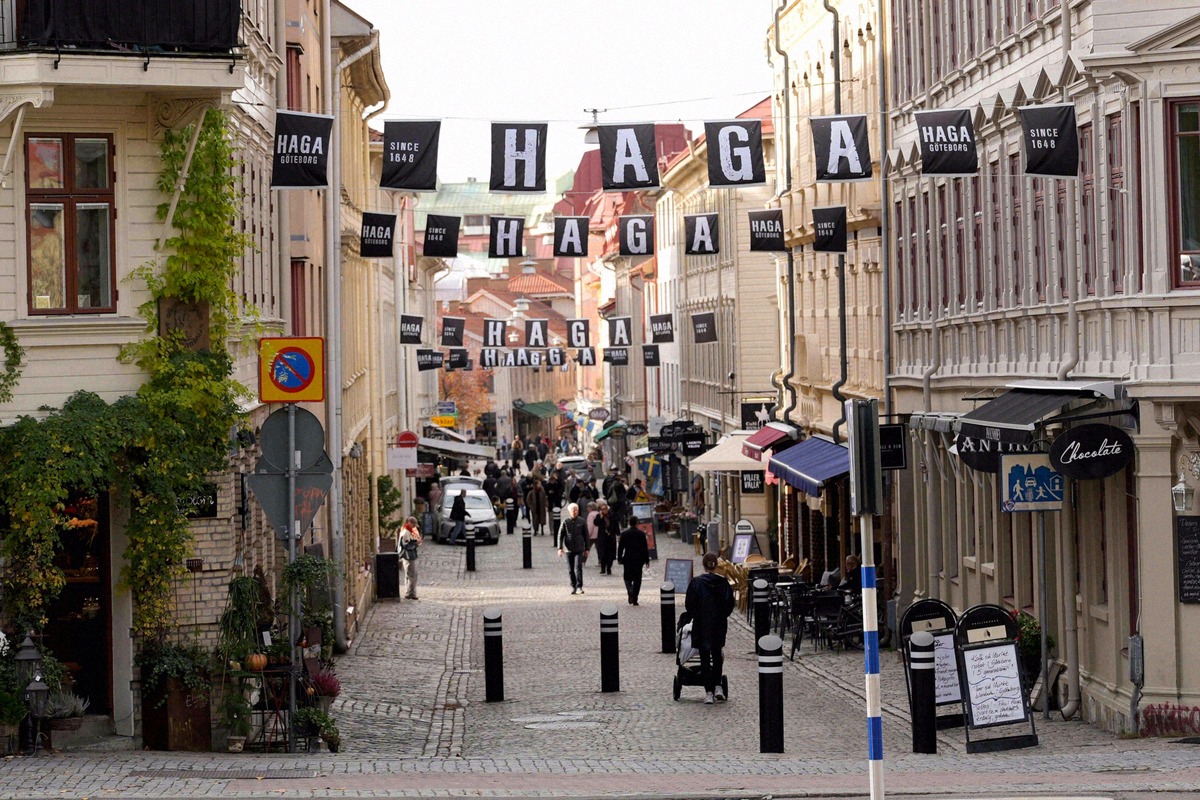
Haga, cobblestones, fika and character
Haga is Gothenburg's oldest suburb, laid out more than 350 years ago and one of the city's oldest neighbourhoods. Its heart is the pedestrianised Haga Nygata, lined with preserved Landshövdingehus buildings. The neighbourhood is considered Gothenburg's "fika capital", with independent cafés and its famous plate-sized cinnamon buns. Local addresses include the vegetarian Restaurang Solrosen, the soap and candle maker Tvåla & Tvaga, and the craft shops Haga of Sweden and Sintra. Above it stands the fortress Skansen Kronan with panoramic views, with the Hagabadet spa nearby.
Haga is charming but small. It's within walking distance of the city centre and borders directly on Linnéstaden and the park Slottsskogen.
- Pro, the most atmospheric, historic neighbourhood, ideal for strolling and fika.
- Pro, walking distance to the centre, Linné and Slottsskogen.
- Con, only a small hotel supply of its own. The nearest larger hotel is the Clarion Hotel Draken, about 500 metres away; nearby you'll find hostels such as the Linné Hostel, Slottsskogens Hostel and STF Stigbergsliden. If you want a larger hotel, look to the centre or the Avenyn instead.
Linnéstaden, relaxed, local and by the city park
Linnéstaden suits anyone who wants a more laid-back, less touristy base. Independent shops and cafés set the tone by day; by evening it turns into a lively night-out district. Its main artery is the tree-lined Linnégatan, running from Järntorget square to Slottsskogen park, known for its density of restaurants, from craft-beer and tapas bars to plant-based and Nordic-Italian concepts such as Bar Italia, Borgskogs or Coco Orangerie.
Its location right by Slottsskogen is a real plus: the large city park is great for a picnic before dinner, and the tram gets you into the centre quickly. Linné is also a good pick for a tight budget, it and neighbouring Majorna have the largest concentration of hostels and cheap beds.
- Pro, local character, an excellent restaurant scene, right by the park.
- Pro, the best area for budget stays and hostels.
- Con, a little further out than the centre and the Avenyn; you'll rely on the tram to get into the centre quickly.
Korsvägen, the shortest walk to Liseberg and Universeum
If you're travelling with kids, or the big rides and attractions are your priority, the transport hub Korsvägen is the most practical base. This is also home to the Gothia Towers hotel complex; the tram stop is only about 100 metres from the entrance. Liseberg, with over three million visitors a year, one of Europe's most popular amusement parks, expanded for 2026 with attractions such as the year-round Kaninlandet and Stormvåg, sits opposite, as does the national science centre Universeum and the Museum of World Culture. All three are within about a ten-minute walk.
Transport links are strong too. Trams 2 or 4 run from the central station to Korsvägen, and tram 5 from Brunnsparken. And the Landvetter airport bus stops right in front of the Gothia Towers in about 20 minutes, a real plus if you're arriving late or leaving early.
- Pro, unbeatably short walks to Liseberg, Universeum and the Museum of World Culture, ideal for families.
- Pro, the airport bus stops right outside.
- Con, outside Liseberg and the exhibition halls, the area feels less atmospheric than the historic neighbourhoods; you'll need the tram to reach the liveliest parts of downtown.
Practicalities, getting there, prices and driving
Whichever neighbourhood you choose, a few basics apply everywhere. The central station, Gothenburg Central Station, sits at Drottningtorget on the northern edge of downtown, right next to the Nils Ericson bus terminal and close to Brunnsparken and Nordstan. From Landvetter Airport, the Flygbussarna bus terminates there, taking roughly 30 to 40 minutes with frequent departures from early morning until late; Korsvägen is one of its stops along the way. More detail in the guides Landvetter Airport to the City and Getting to Gothenburg.
For a rough budget guide for 2026:
- Budget / 2-star, from around 60 to 95 USD, single rooms from around 850 SEK including breakfast.
- Mid-range / 3-star, roughly 90 to 115 USD.
- Luxury, roughly 125 to 230 USD; top-end properties like the Upper House cost considerably more (around 4,900 SEK and up).
Prices swing sharply by season: January is the cheapest month, averaging around 137 USD a night, July the most expensive at around 242. If you're travelling in peak season, book central hotels early.
You won't need a car in the city, the tram network covers every neighbourhood. If you're driving anyway, budget for parking: it's priciest in the centre and gets cheaper towards the outskirts. In the Nordstan car park, an hour costs around 30 SEK during the day (06:00-18:00), only about 5 SEK at night (22:00-06:00), and is sometimes free in the evening. On-street parking is paid via the Parkering Göteborg app. For how to combine tram, ferry and bike hire, see the guide Getting Around Gothenburg; for when to visit, see Best Time to Visit Gothenburg.