
Day Trips from Gothenburg
Marstrand, Bohuslän & more
Fortress island Marstrand, the fishing villages of Smögen and Fjällbacka, Läckö Castle on Lake Vänern, and the locks of Trollhättan, day trips from Gothenburg with directions and tips.
Contents
Gothenburg is a good base for exploring Sweden's west coast and the lake country behind it. Several rewarding destinations lie close enough to fit comfortably into a single day, from the car-free fortress island just off the coast to the baroque castle on the EU's largest lake. Which one suits you best depends mainly on whether you have a car and how far you're willing to travel.
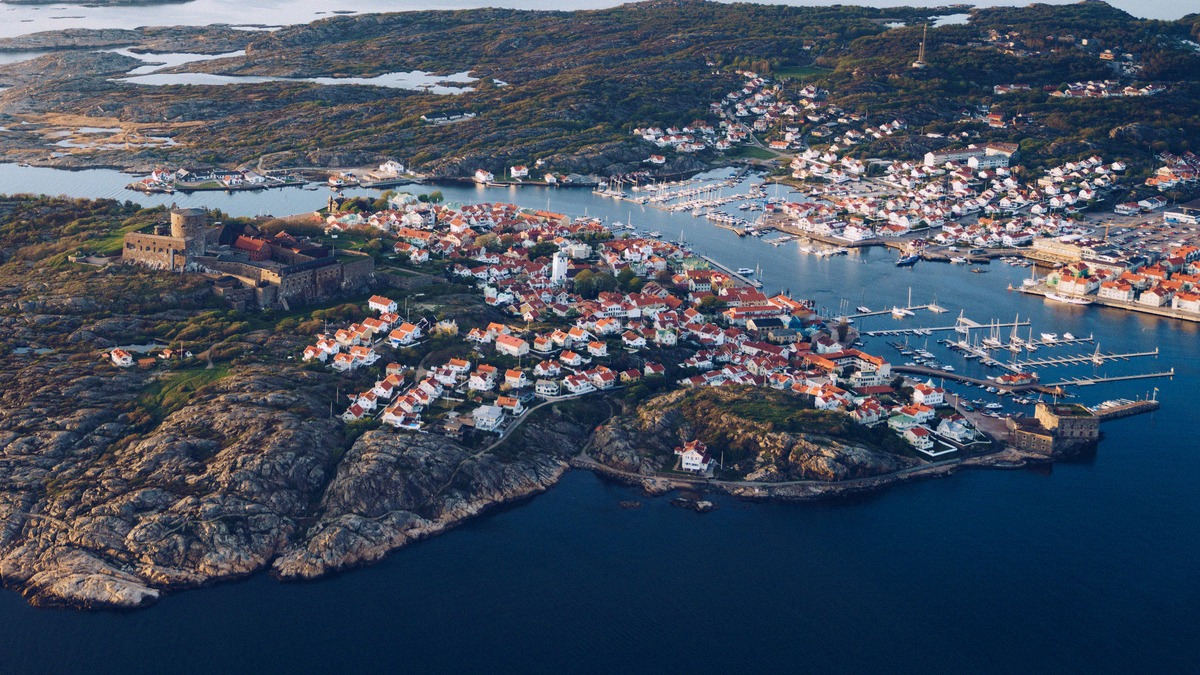
Marstrand, a fortress island reachable without a car
The classic day trip goes to Marstrand, about 45 kilometres northwest of Gothenburg. By car it's roughly a 45-minute drive along the E6 towards Oslo, turning off onto road 168 at Kungälv; the road ends at the Marstrands Färjeläge ferry landing on the island of Koön. Getting there without a car works just as well: buses 302 and 312 run daily from the Nils Ericson Terminal at Central Station to the Arvidsvik terminus on Koön, only about 50 metres from the landing, a journey of around an hour.
The island of Marstrandsön itself is reachable only by passenger ferry, since it's car-free. The small ferry runs every 15 minutes during the day (on-call every 30 minutes at night), and the crossing takes only about two minutes. If you arrive by bus, the outbound crossing is already covered by your ticket; the return crossing to the mainland is free regardless. If you arrive by car, you park at the entrance to Koön, the closer to the landing, the pricier. Spaces fill up quickly in summer, so an early or late arrival and the slightly more distant car parks (such as Brandstationen Parkering or Danska Sten Parkering) are worth considering; in winter most car parks are free.
Carlsten Fortress, opening hours and prices for 2026
The landmark of Marstrandsön is Carlsten Fortress (Carlstens fästning), perched high above the town. It's open seasonally only, only the hotel and banqueting area is accessible year-round. For 2026, these are the visiting hours:
- 3 April to 31 May, weekends 11:00 to 15:00.
- 1 to 30 June, daily 11:00 to 17:00.
- 1 July to 9 August, daily 10:30 to 18:00 (peak season).
- 10 to 31 August, daily 11:00 to 17:00 (guided tours by advance booking only from 24 August).
- September, weekends 11:00 to 15:00.
Admission in 2026 costs 120 SEK for adults and 60 SEK for children aged 5 to 15; children under 5 and dogs go free. Higher prices apply during the Fortress Games special event (adults 195 SEK, children 95 SEK). The fortress and the island atmosphere are at their best in summer, when swimming season is also in full swing, which makes the warmer months the best time to visit Marstrand. The island is small enough that a fortress visit and a stroll through town fit easily into one day.
Smögen and Fjällbacka, the Bohuslän coast
Further north, the rugged Bohuslän coast stretches out with its red fishing cottages and smooth granite rocks. Smögen lies about 85 kilometres from Gothenburg, roughly a two-hour drive via the E6 and road 163. The village is still an active fishing port; the catch is auctioned off on weekdays. The main sight is the wooden harbour boardwalk Smögenbryggan, its converted warehouses now home to cafés, shops and seafood restaurants. Along the way lies the Sotenkanalen canal, with a walking path running alongside it.
A little further south, about ninety minutes from Gothenburg, lies Fjällbacka. The village is known for Ingrid Bergmans torg, a square named after the actress, who spent nearly every summer on the nearby island of Dannholmen from the late 1950s until 1982 and called Fjällbacka her "paradise on earth". A wooden staircase through the rock gorge Kungsklyftan on Vetteberget hill leads up to a viewpoint; the gorge was also a filming location for "The Robber's Daughter" (Ronja Rövardotter). The village also features as the setting for Camilla Läckberg's crime novels. The main attractions in Smögen and Fjällbacka are free to visit, costs come mainly from dining, boat and archipelago tours, and seasonal parking, not fixed admission fees. Smögen and Fjällbacka lie only about 40 minutes apart and can in principle be combined, but that's ambitious for a single day; most visitors enjoy one of the two at a relaxed pace instead.
Läckö Castle on Lake Vänern
Northeast of Gothenburg lies Lake Vänern, the largest lake in the EU. On its shore, on the Kållandsö peninsula near Lidköping, stands the baroque Läckö Castle (Läckö slott), a rewarding destination for a longer day trip, well suited to a car journey. Allow roughly two hours' driving time; no official distance figure can be reliably quoted.
Läckö also opens seasonally. In 2026 the castle is open daily from 14 June to 13 September, 10:00 to 18:00, during the main season; before (6 to 12 June) and after (mid-September into late autumn) only guided tours or reduced hours are available, and the castle is closed on 13 June for an inauguration event, with the new exhibitions opening on 14 June. Admission costs from 110 SEK for adults, while children and young people up to age 26 go free; prices are staggered by season. The ticket includes all the summer exhibitions, the castle church and the small castle garden.
Trollhättan, locks and waterfalls
About 75 to 80 kilometres north of Gothenburg lies Trollhättan, roughly an hour's drive away. The town is known for two things, the waterfalls and the historic locks, and it's worth knowing the difference before you go.
The Trollhättan Falls (Trollhättefallen) normally run dry; the water is only released on fixed dates (Fallpåsläpp). In 2026 that happens exclusively during Fallens Dagar on 17, 18 and 19 July, at 12:00, 14:00, 16:00, 18:00, 20:00 and 23:00 each day. For energy and safety reasons, Vattenfall no longer carries out regular releases outside this festival; spontaneous releases to regulate the water level of Lake Vänern are possible but unpredictable. If you want to see the water spectacle, plan your visit precisely around these three days. Fallens Dagar is Sweden's oldest town festival and free to attend.
Separately, the locks of the Trollhätte Canal are worth a visit in their own right. Here you can see three generations of lock systems side by side, protected as a national heritage site. The full canal between Gothenburg and Vänersborg runs 82 kilometres and climbs 44 metres of elevation through six locks, four of them in Trollhättan. You can watch ships passing through the locks, visit the canal museum, and explore the area on walking trails (including a roughly 2.5-kilometre loop with a viewpoint from Kopparklinten). The lock area draws visitors year-round and works just as well when the falls are running dry.
The simplest trip, the archipelago right off the city
If you don't want to commit a whole day or a car, staying close to town is enough. The southern Gothenburg archipelago is the simplest "day trip" right off the city, car-free islands reached by tram and ferry, often manageable in half a day. For exactly how that works and which islands are worth it, see the guide The Gothenburg Archipelago.
For every other destination, having your own car gives you the most flexibility, especially for Bohuslän, Läckö Castle and Trollhättan. Marstrand, on the other hand, works well by bus too. For how to get around without your own car, see the guide Getting Around Gothenburg; for when the west coast looks its best, see the best time to visit.